Sunday, December 7, 2008

Reflection on the Texts as a Set

Reflection on the Texts as a Set

All of the books I critically reviewed, Ian’s Walk, My Brother Sammy and Andy and His Yellow Frisbee, all positively showed behaviors and relationships that children with autism can have. Each book had some similarities as the others. Each book showed and explained the fact that children with autism like to play alone and like to do things differently. Each of the three books was about a male character with autism and all involved siblings as well. The books all showed or explained how the sibling felt in the beginning regarding their sibling with autism and showed how they grew to accept and understand their sibling better as the story went on. These three books, as a set, positively tell stories involving a child with autism and show how life can be for them and their siblings.

I recommend all of these books and especially recommend, My Brother Sammy, because it covers many aspects of autism in a very positive way and Sammy’s sibling also narrates it, which I think is a very important view to hear the story from. The reader gets to hear from the sibling what it is like having a brother who is autistic. Two of the three books, Andy and His Yellow Frisbee and Ian’s Walk both contain pages dedicated to explaining what autism is. The author of Andy and His Yellow Frisbee also chose to include an about the author section, which the other two authors chose not to have. In Mary Thompson’s about the author section, the reader learns that she is a mother to four children, one who has a disability. I thought it was interesting knowing this fact because it shows that she is even more an insider on the topic. But all three authors wrote wonderful stories that showed how a child with autism may behave and certain relationships that they may have. 

Saturday, December 6, 2008

Review of a Professional Resource: "Characterization of Developmental Disability in Children's Fiction"

Characterization of Developmental Disability in Children’s Fiction

Dyches, Tina T., and Mary A. Prater. "Characterization of Developmental Disability in Children’s Fiction." Education and Training in Developmental Disabilities 3 (2005): 202-16.

            This article discusses the use of characters with disabilities in children books and how these types of books have “evolved over time” (202). The first piece of information that the article talked about was the fact that it is very important that characters with disabilities in children’s literature should be “both positive and realistic” (202). I felt that in all three of the books I analyzed, Ian’s Walk, My Brother Sammy and Andy and His Yellow Frisbee, showed the characters in both a positive and realistic way. The books all showed realistic behaviors of how a child with autism may act. For example in Andy and His Yellow Frisbee, Andy is shown and described with a love for spinning objects, which is a common behavior of children with autism. Also in all three of the stories, the main character is shown or described as liking to do things alone and not with others. This is a common behavior as well of children with autism, which shows that all three of these books were portrayed in a very realistic matter.

The article also reports facts from a study in 1999 that compared 68 children’s books published between 1965 and 1996 involving characters with disabilities. Then the article focuses more on “analyzing the characterization of individuals with developmental disabilities, as well as related issues discussed within the plot, in children’s books with an initial publication date of 1999-2003” (203).  The study reviewed and analyzed “34 books and 11 were picture books and 23 were chapter books” (204). Out of these titles, the only one mentioned that I critically reviewed was My Brother Sammy. Also the article brings up the fact that “a majority of the books depicted males with developmental disabilities” (205). I found this fact very interesting, especially due to the fact that in all of the books I reviewed the character with the disability was indeed a male. “The ratio of male and female characters with autism spectrum disorders in the books reviewed (4.25 boys: 1 girl) closely align with the actual ratios (4-5 boys: 1 girl)” (212). This was interesting to read because I did find it odd that in all of the three books I reviewed the character with autism was male.

The article as well discusses different types of relationships that are present in these types of books. One type of relationship that was brought up a lot was relationships with siblings. In all of the three books, Ian’s Walk, My Brother Sammy and Andy and His Yellow Frisbee, there are sibling relationships shown. Also in all three of the books the sibling without the disability grow and “improve their feelings regarding their sibling with DD” (214). Also a topic of feelings of guilt is discussed in this article. “Several nondisabled characters were depicted as feeling guilty in various ways regarding their relationship with the character with DD” (211). The article also mentions that the “nondisabled characters learned to accept or began to understand the individual with DD” (211). In all three of the books the sibling(s) grew to accept their brother and learned that it is okay to have a “special” sibling. For example in My Brother Sammy, the sibling ends the story by saying “Sometimes I think I’m lucky to have a special brother because that makes me special too” (Edwards). Or in Ian’s Walk, when his sister says, “Ian sniffs all the bricks he wants, and I don’t care who’s watching” (Lears). Here Ian’s sister and Sammy’s brother have learned to accept their sibling with autism and love them unconditionally regardless.

As well as the theme of relationships, “recreation was a minor theme in the books analyzed for this study, frequently represented informal events” (211). Events listed included going for walks, which is what Ian’s Walk is all about. “Schooling and Education” was also another theme discussed in the article. “Some characters with DD were depicted as being educated in self-contained schools, such as My Brother Sammy” (211). Sammy’s brother explains this fact on the very first page of the book. He says, “My brother Sammy doesn’t got to school in the big bus with me. He waits for his bus to come and pick him up and take him to a different school instead” (Edwards).

The article lastly explains that all of the books that were analyzed for this study “qualified to be considered for the 2002 and 2004 Dolly Gray Award in Children’s literature” (214). The Dolly Gray Award recognizes high quality children’s literature that has characters with developmental disabilities. I also found out from the article that, My Brother Sammy was selected for the 2002 award. I was also happy to read that, “The most current fictional children’s books that characterize people with developmental disabilities are generally more positive than they have been in the past” (215). This makes me happy that books about such individuals are becoming more positive and used more in children’s literature. Children and adults have to realize that people with developmental disabilities are still human and just act in different ways, and by saying different does not mean a “bad different” just a “special or unique different”. Once more of these positive stories are created and read, it will allow more people to realize and accept individuals with developmental disabilities.   


Friday, December 5, 2008

Final: Critical review of book: Ian's Walk


Lears, Laurie, and Karen Ritz. Ian's Walk: A Story about Autism. Boston: Albert Whitman & Company, 2004.

When I open the first few pages of the children’s book, Ian’s Walk: A Story about Autism, a page entitled, “A Note about Autism”, graces me. Initially, I feel the note is a great aspect to the book. The note discusses the different kinds of feelings siblings of children with disabilities, such as autism, may have. “They may experience anger that autism has ‘happened’ to their family, embarrassment regarding the way their sibling looks or acts, and feelings of isolation because other children do not have siblings like theirs.” I think that it is wonderful that Carol P. Rolland, Ph.D. and Mary Kay McGuire, M.A, the authors of the note, focus on the feelings of the siblings, and not necessarily only focus on the child with autism or other disabilities. The only aspect of the note that stuck me as odd was the fact that the authors, one who is a chief psychologist, refer to Julie, the sibling who does not have autism as “the healthy sibling in this book”. As a special education major, I do not like the fact that they call her “the healthy sibling”. This makes me question the authors, do they feel that Ian, the sibling who is autistic, is not healthy just because he has a disability such as autism. In my opinion, it would have been more effective and correct to refer to Julie as the sibling who is not autistic or as the sibling who does not have a disability. Besides this way of classifying Ian as the “unhealthy sibling,” I did like the notes overall message about children who have siblings with disabilities and their different emotions and feelings that go along with it.

Ian’s Walk begins by showing a frustration a sister has due to her brother who has autism, which the note explained was very common. “Aw, Ian, why don’t you stay here?” Tara, the older sister says to her brother, who is autistic, about coming to the park with her and their other sister, Julie. Ian ends up going along with his sisters for a walk in the park. The next part of the story, Julie, the narrator, explains at the beginning of each page that Ian sees, hears, smells, feels, or tastes things differently. Throughout each of these pages there are beautiful water-colored, realistic illustrations, which show Ian doing certain things differently than his sisters.

            Ian then gets lost in the park and his sisters become very distressed and start to look for him and ask different people in the park if they have seen him. To try to find Ian the girls attempt to think like him and end up finding him swinging from a big bell in the park. They hug him tightly, although they know he “doesn’t care for hugs.” I like that the author put this fact in about Ian not liking hugs because I know that most children with autism do not like being touched or hugged due to their disability. I feel that the author includes this information very tactfully by having the sister say it and by also having the illustration show it as well.

            Although Ian’s siblings at first view his coming along for the walk as an inconvenience and slight annoyance they end up having a very nice walk. The sisters explain to the readers that, “Ian’s brain doesn’t work like other people’s,” but then end up embracing his different ways of doing things on their walk home from the park. I liked this book a lot because it shows the different feelings siblings of those with disabilities can have but in the end they realize how much they still love Ian and realize that they don’t care who’s watching as they walk home and allow Ian to walk home they way he likes. The girls learn that their brother is different and does like to do things differently but once they cannot find him they realize that it is okay that he is different and that they still love him for the person he is. 

Image From: http://images.barnesandnoble.com/images/14400000/14402706.JPG

Final: Critical review of book: Andy and His Yellow Frisbee


Thompson, Mary. Andy and His Yellow Frisbee. New York: Woodbine House, 1996.


Andy and His Yellow Frisbee is about a boy named Andy who is autistic and loves playing with his yellow frisbee everyday during recess. His older sister, Rosie, goes to the same school and always watches out for him and worries about Andy during recess. In the story Rosie is playing soccer one day during recess and looks over at Andy spinning his frisbee and sees a girl, Sarah, hanging around close by him. Rosie gets worried about how Andy will react and leaves mid-game and runs over to Andy to make sure he is okay. When she got to Andy, Rosie saw the girl playing close to Andy with a pink frisbee. The little girl asks Andy if he can show her how to spin the frisbee and Andy does not reply but does move a little farther away from the girl. The narrator explains that Andy does this because he is autistic and explains that he likes to keep to himself. The girl with the pink frisbee ends up asking Rosie, Andy’s sister, if she wants to play catch with her frisbee. Sarah and Rosie end up playing together while Andy is still sitting spinning his yellow frisbee.

I thought this book did a good job of showing how siblings of autistic children can feel the need to, at times, protect their siblings. Rosie, for example loved playing soccer, but while she was playing the narrator explained that she would constantly look over to make sure her brother Andy was okay. When Rosie sees a girl coming close to Andy she runs over, leaves her game and makes sure that Andy is okay. I thought this was a very kind act on Rosie’s part but also showed that sometimes siblings of autistic children have to give up things for themselves every once and awhile, since she had to leave the soccer game and miss playing in the game for the rest of recess. This act also demonstrated sibling love and how Rosie would do that without hesitation for her brother.

One aspect or description of Andy in the book that I wasn’t sure if I liked or not was the fact that the narrator said that “Nothing was simple about her brother. Mom had told her that was because Andy had autism.” I think that by saying “nothing was simple about Andy” is kind of saying in other words nothing is “normal” about him. I think that this sentence describing Andy is alienating him and then blaming it on the fact that he had autism. I do like how the narrator describes Andy’s love for spinning objects as a special talent. This explains why he loves spinning his frisbee and also discusses other objects that he loved to spin such as coins and dinner plates.

Another component of the story that I liked was how the author incorporated little facts about autism subtly throughout the book. For example, the narrator explains that, “Even when he was a baby he didn’t want to be held or cuddled.” I like this because it is still part of the story but gives some inside information about autism to the reader. Another example of this was when the narrator explained that Andy had a hard time with other people and new situations and could get upset easily in such situations.

The last page of the book was entitled, “What is Autism?” Here the narrator explains about Autism and how it affects about 400,000 children and adults in the U.S. Here the narrator also relates things back to Andy. The section also explains “that many children with autism feel sensory input differently than other children do.” And also says that spinning a frisbee, like Andy did throughout the story, can help children with autism deal with sensations. I liked that the book had this page to inform the reader a little bit more about autism. Also on the back inside cover, the about the author section, explains that Mary Thompson, the author, “is a mother of four children, including one with disabilities.” I think this is a cool fact to know about the author because it shows that she is an insider to information about disabilities with children and also how siblings react and act with their sibling who has a disability. I also really like how the “What is Autism” section ends, by saying that, “With extra help, all of them can learn important skills in school and become a valuable part of their community.” This is a nice quote because it ends the section and story on a positive note and implies that just because a student or child has autism does not mean that they cannot become a valuable part of their community or school. 

image from:http://www.autismbookstore.com/Merchant2/graphics/00000008/band01.jpg

Final: Critical review of book: My Brother Sammy


Edwards, Becky. My Brother Sammy. Brookfield, CT: The Millbrook Press, 1999.

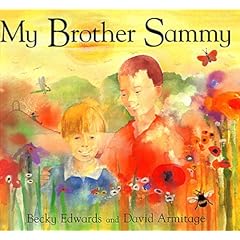
The book, My Brother Sammy, is a touching story about a boy and his brother Sammy. Sammy is autistic and his mom explains to Sammy’s brother that Sammy is special and that’s why he does things differently than other kids. The story is told through Sammy’s sibling, whose name is not given. The first part of the story, Sammy’s sibling compares himself and Sammy and explains that Sammy does not take the same bus or like the same things as he does. He then says each time after explaining a difference between them that it is because, “my mom says it’s because he’s special.” He also uses different phrases, each page, to describe how it makes him feel that his brother doesn’t or cant do certain things with him. He uses phrases such as, I wish in a… “lonely sort of way,” frustrated sort of way,” and “sad sort of way” that Sammy could do certain things with him. The sibling realized that it was sometimes not easy having a “special brother”. 

Later in the story, Sammy knocks over a tall tower his brother has made and Sammy’s brother becomes extremely angry and upset. The narrator, Sammy’s brother, then expresses to his mom that he wants a brother who can, “come to school in the bus with me” and how he wants a brother “who likes to play with me and my friends.” He also lists other things that he wants in a brother and ends his rant by saying that, “I DON’T WANT A SPECIAL BROTHER.”

Right after hearing his brother say that, Sammy pointed directly at his brother, who had just said that, and says, “SPECIAL BROTHER.” His mom then explains to him that this was Sammy’s way of telling him that he was a special brother. This then made him feel very special and he and Sammy end up playing together in Sammy’s “different sort of ways,” as his brother puts it. Sammy’s brother begins to see that it can be fun playing with Sammy the way Sammy likes to play. The narrator, Sammy’s sibling, ends by saying that, “Sometimes I think I’m lucky to have a special brother because that makes me special too.”

            I felt that this book was beautifully written and showed two brothers, one autistic and one who was not, and their relationship. It was very meaningful and powerful that the author, Becky Edwards, chose to have Sammy’s brother narrate the story. This way he was able to express and explain to the reader his frustrations or thoughts regarding certain feelings towards his brother. The book does a very good job of explaining how a child with autism may act and how a child may respond to their sibling’s different ways of acting. I liked how the mom uses the word “special” to describe Sammy and to help explain why Sammy does many things differently than him. I also really liked the last line of the story and felt it was a great ending. The line, which I mentioned above, is said by Sammy’s brother, “Sometimes I think I’m lucky to have a special brother because that makes me special too.” I felt this was a very positive way for Sammy’s sibling to think and also shows a positive example for other children who have siblings with disabilities as well. 

(image from http://ecx.images-amazon.com/images/I/61SHQFYDRXL._SL500_AA240_.jpg

Wednesday, December 3, 2008

Final Post

      Looking back at one of my first wall posts, which I wrote towards the end of August, I am able to read what I had hoped to take away from this class. I am very happy to say that I have indeed taken away even more than I had hoped to from this class. I said that I “wanted to learn more about different cultures and how to teach them to children without talking too much about stereotypes and without offending anyone of different cultures.” I have definitely learned a lot about different cultures and have become very aware of different stereotypes and generalizations. I also used to think those two words, stereotypes and generalizations were the same thing and I now know the difference between them. From the article written by Carlos E. Cortes, “Helping Students Understand Stereotyping, ”I learned that generalizations tend to use or imply such words as some, many, occasionally and most. Stereotyping tends to use or imply all or almost all when dealing with certain groups or group members” (Cortes, 6). I know now not only the difference between the two words but understand when and how to use them.

            I also wrote in that same beginning post that I wanted …”to learn how to create an open minded, comfortable classroom environment that allows my students to be open to new ideas and different cultures than their own.” I think that this class has really shown a positive example of how a classroom should be ran. I think that our classroom environment has been very comfortable and has allowed most students to expand their knowledge on many different cultures. I have learned so much about different religions, cultures, orientations, and cross-culture relationships. I have taken away so much from this class and feel that I am now even more open-minded than I was before taking this class. I have learned to be more sensitive towards different stereotypes and feel that I can teach and show my future students how to be as well. I am very glad I took this class and have enjoyed it. Thank you for showing me, a future teacher, how to conduct an open and comfortable classroom.  

Tuesday, November 25, 2008

It's Elementary


While watching the video, "It's Elementary," I liked being able to hear different opinions from different aged children. A fourth grade teacher in the video directed her class to write in groups what they thought of when they heard the words gay or lesbian. I was very surprised by what some of the students had written or said that the camera had caught. One boy said "ewwww" and then another boy said "write that, that is what he thinks of". Another word that was 
written down was unrealistic. I was sort of confused with this word, wondering what the student meant by it. Did they think that it was unrealistic for gays and lesbians to be accepted or unrealistic for there to be people who are gays or lesbians. Some other words that were listed by the students were movie, sick, gross, pervert and many others. When the teacher asked them as a group where they got most of their ideas from many said specific movies or talk shows and the news. I was then surprised when, I believe, younger students were asked to discuss what they thought it meant to be gay or lesbian. Their responses were much more open minded and less negatively viewed. One student said that it means that "a person who is a boy is in love with another boy, or a girl is in love with another girl." Another student said that it meant "laughing at someone who is gay." And by this response, I believe the student meant that he sees people laugh at gay or lesbian individuals. One specific girl mentioned that she hears her parents talking about how it is wrong to be gay or lesbian but she said that she "thinks that is just how they are." I liked that she said this, because it is showing that she has her own opinion and does not necessarily feel it is wrong just because her parents say so. Another male student had a response that I really liked, he said that "one meaning for gay is happy, so maybe it is because they are happy because they are in love with each other." I liked this response because it was very rational and well thought out. The point that he is making is that when two people are in love, no matter if they are gay or lesbian, they are still happy, and that is why he felt that was the best rationale, since he did know that gay could mean happy. Also in the younger grades, such as first and second, the classes made books, where each student does a page accompanied by their own illustration. One in particular book the class made was a book about how everyone is equal, and the subtitle was "a book about gays and lesbians". Each student wrote a page dealing with the fact that just because a person is gay or lesbian does not mean they should be treated any differently. I liked that the teacher had each student read their page out loud to a few other classes and explain their illustration as well. I liked this because other classes can still benefit from the information and the students get to hear it from their peers. Also it is nice because on teacher mentioned that there were a few fellow teachers who were gay or lesbian and had a much harder time talking about the topic with their students. The straight teacher said that it helps that she has a husband, so it does not look like she is trying to teach the topic because it pertains to herself. This is why the sharing of the book idea is great, because the teacher's who do not feel as comfortable discussing the topic to their students can still have their students get the information. 
I lastly really liked a parents comment on the whole issue of whether or not it should be allowed to teach or talk about gay and lesbians in elementary schools. The parent said that, "Even if a parent is against it (gay and lesbians) their kids should still know about it and then the kids can come home from school with any questions and then the parent can talk to them about it in their own way." I liked that the parent said this because I think it is very important for children to know what it means to be gay and lesbian and if their parent's do not want to talk to them about it or do want to talk to them about it, I think school is a perfect place for their children to begin learning about it. I agree with this parent and believe that it is okay to talk about gay and lesbians just as it is okay to talk about other cultures, which schools do, so why should it be any different. Learning about gay and lesbians at a younger age, in my opinion, can only help make our future generations more open-minded and more accepting of others.  
Photo from http://www.groundspark.org/images/press_ie_photos/IE_Robbie_highres.jpg